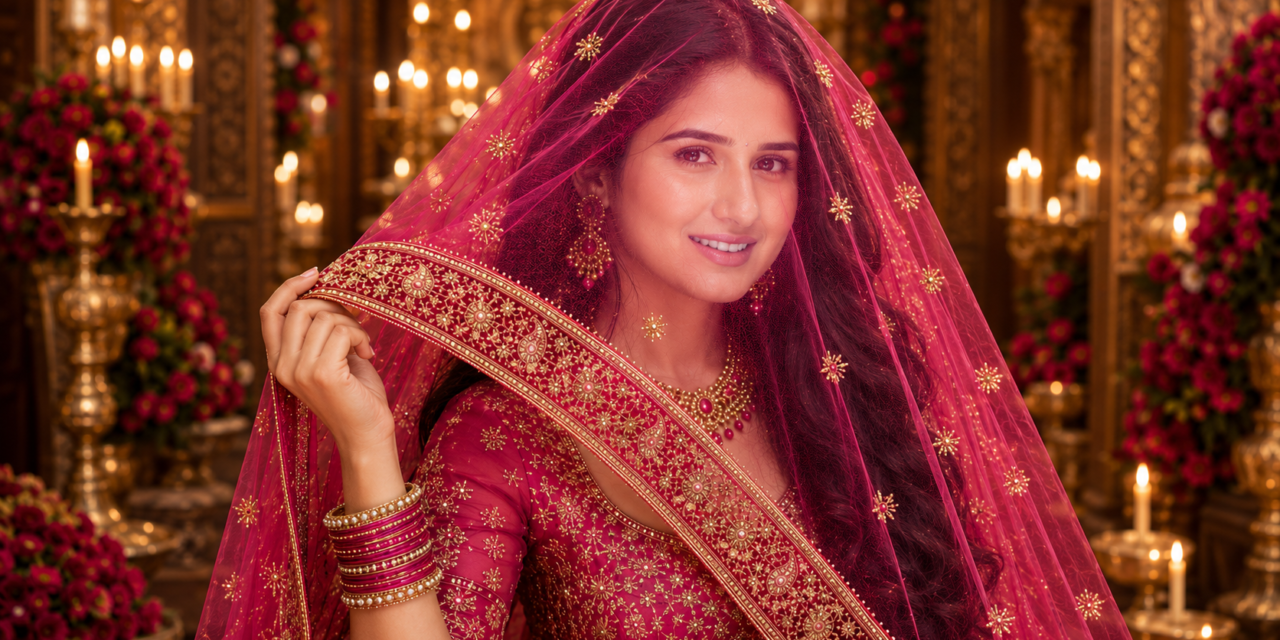
PROMPT OF Bridal Ghunghat AI Photo Editing Prompt with Face Lock
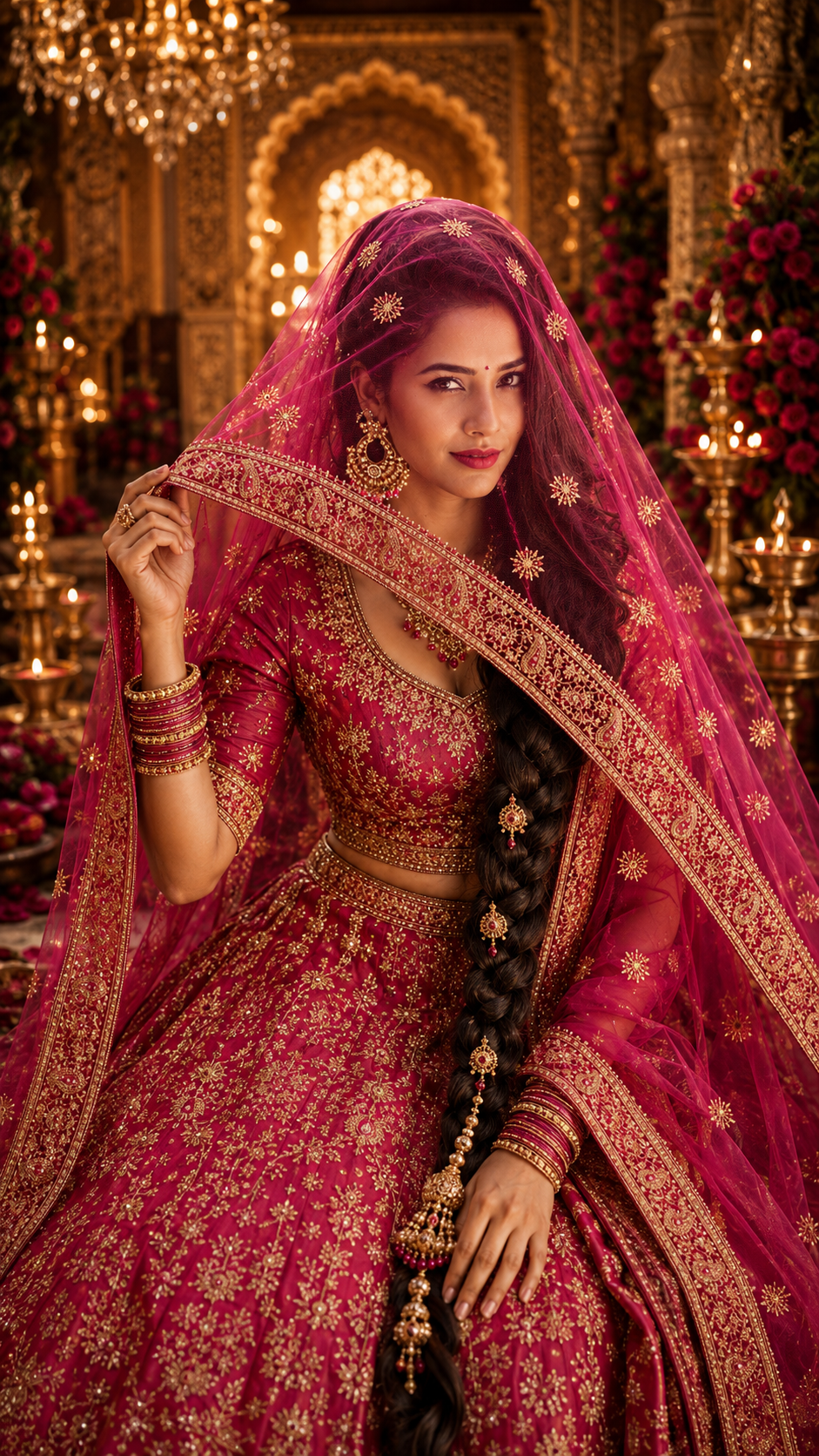
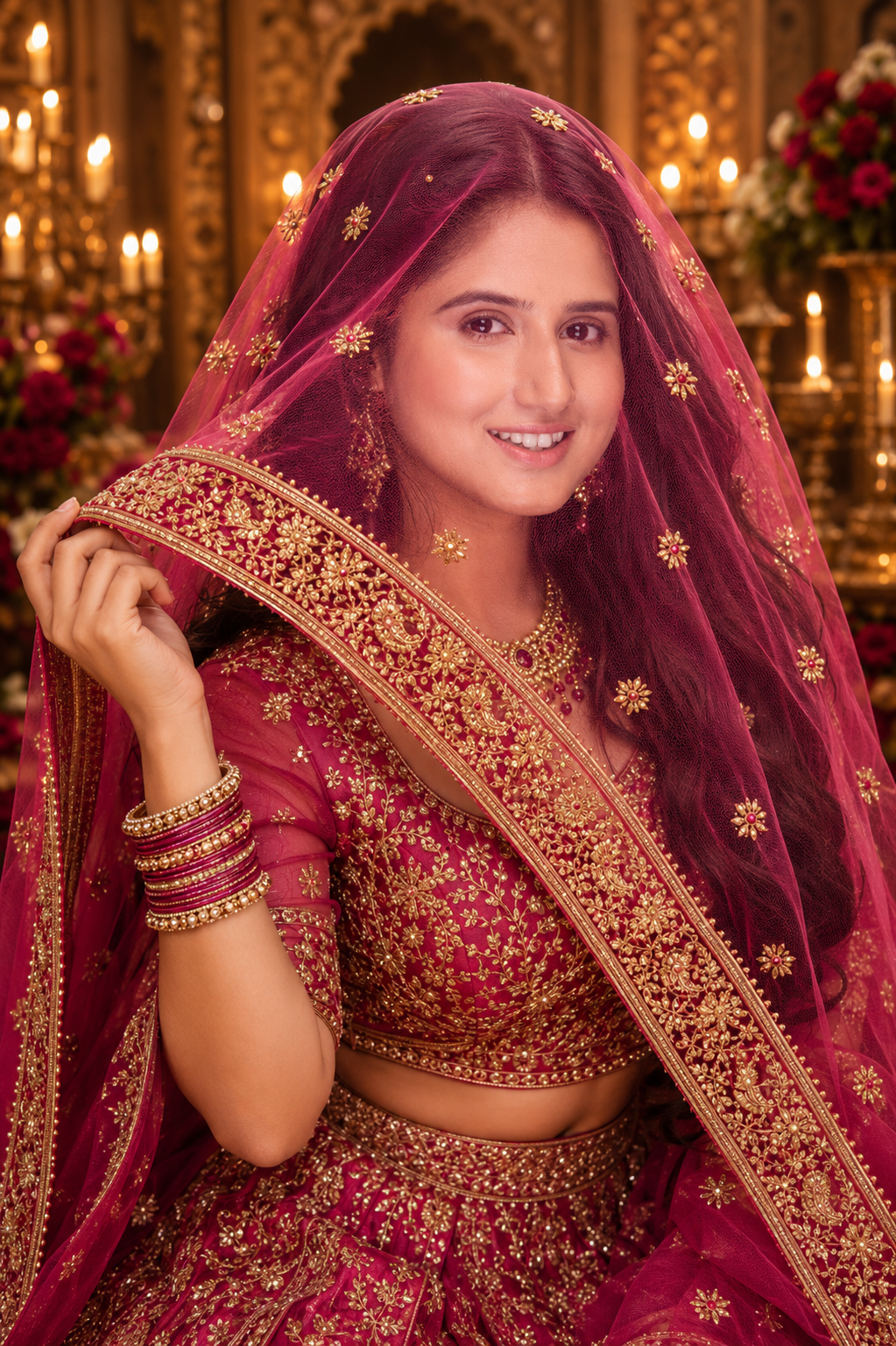
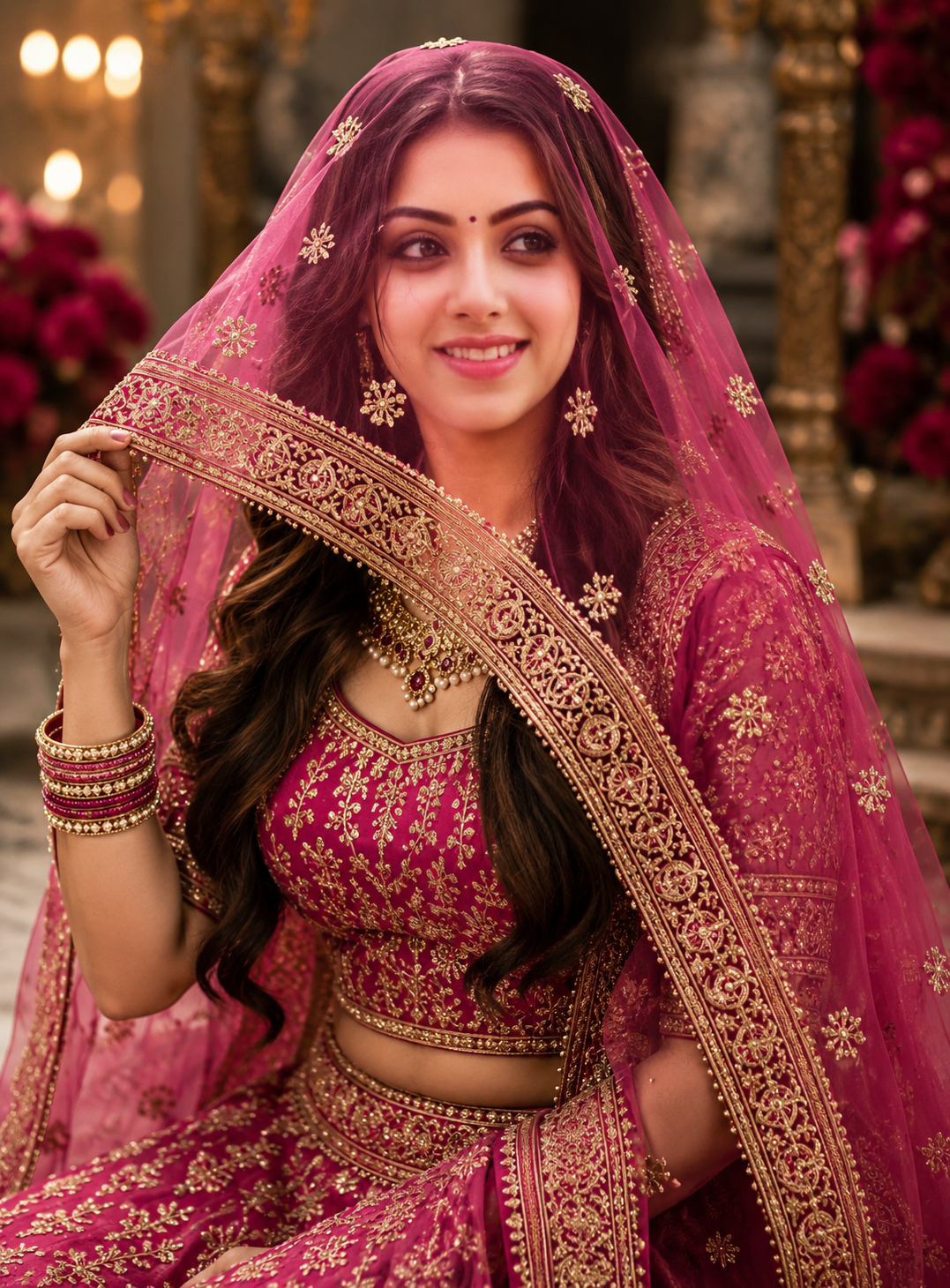
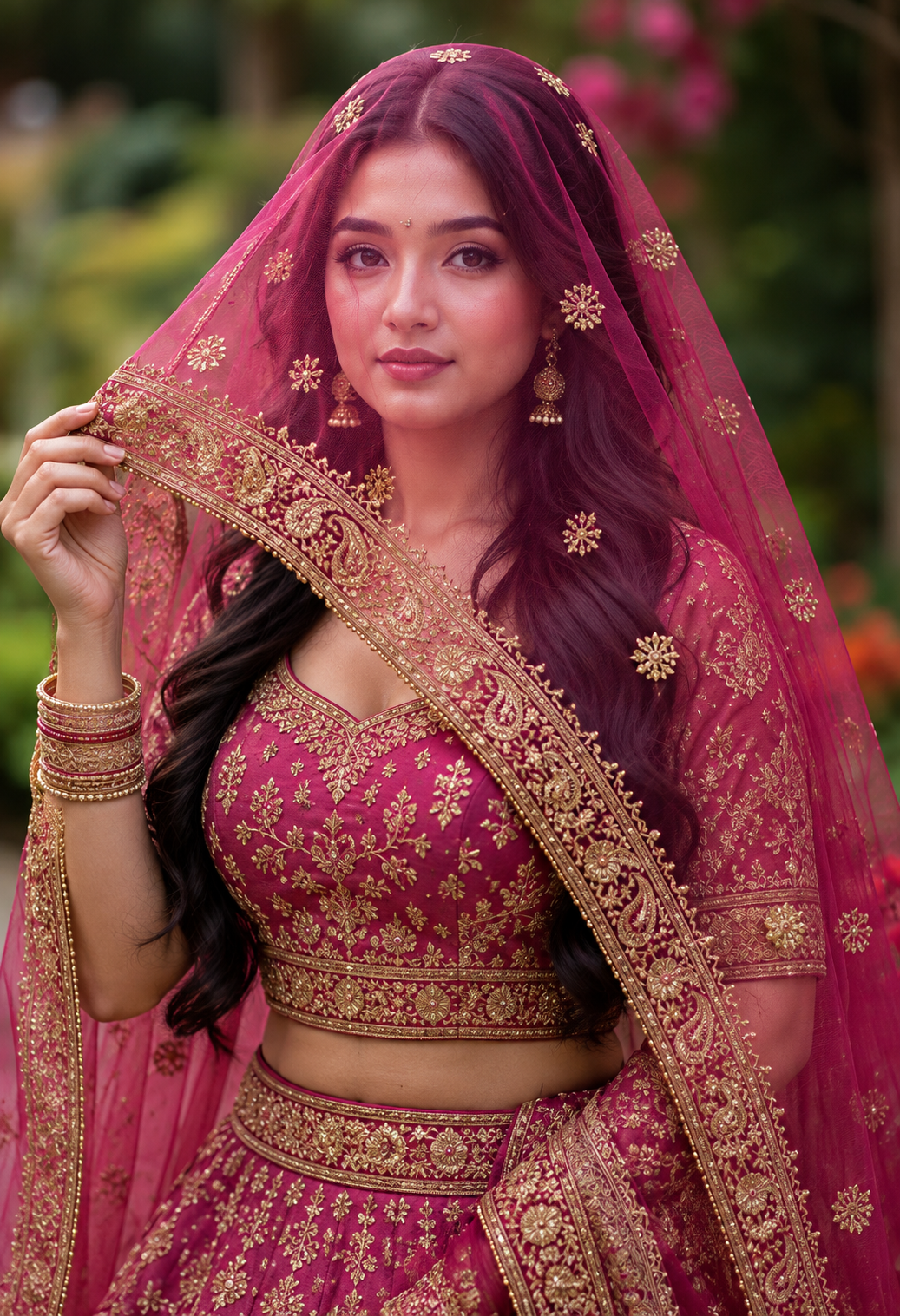
Create an ultra-realistic, highly detailed traditional Indian bridal portrait using the uploaded reference image.
IDENTITY & FACE LOCK — ABSOLUTE PRIORITY:
Use the uploaded person’s exact face and identity.
Do not create a new face.
Do not change the person’s identity.
Do not perform face swap.
Preserve the exact facial proportions, face shape, forehead, eyebrows, eyes, eyelids, nose, lips, cheeks, chin, jawline, skin tone and natural facial characteristics from the uploaded image.
Keep the person instantly recognizable.
Do not beautify or redesign the facial structure.
Maintain realistic natural skin texture, subtle pores and authentic facial details.
MOST IMPORTANT ELEMENT — GHUNGHAT:
The bridal ghunghat is the PRIMARY and MOST IMPORTANT visual element of this image.
Create the exact traditional bridal ghunghat style shown in the reference.
The ghunghat must be made from an extremely lightweight, fine, semi-transparent deep magenta / rani-pink net fabric.
The ghunghat must START FROM THE CROWN OF THE HEAD and come forward over the head.
It must visibly PASS IN FRONT OF THE FACE.
The transparent veil should softly cover the forehead, upper cheeks and front/side portion of the face while still allowing the complete face to remain clearly visible and recognizable through the fabric.
The woman’s eyes, eyebrows, nose, lips and facial expression must remain clearly visible through the transparent ghunghat.
The veil must create a subtle translucent pink/magenta color cast over the face, exactly like a real fine bridal net veil placed between the camera and the face.
Do not make the ghunghat opaque.
Do not hide the face.
Do not place the ghunghat only behind the head.
Do not place it only over the shoulder.
Do not make it look like an ordinary dupatta.
The ghunghat should form a beautiful face-framing shape around the woman’s forehead and cheeks.
One hand should gently hold the front outer edge of the ghunghat near the side of the face and slightly pull it outward.
The lifted edge of the ghunghat should create a graceful diagonal curved line across the composition, closely matching the reference.
The opposite side of the ghunghat should fall naturally from the crown, down along the side of the body and continue toward the back.
The veil must have realistic transparency, delicate mesh texture, visible fine woven threads, natural folds, tiny wrinkles, soft fabric movement and realistic weight.
GHUNGHAT BORDER — EXTREMELY IMPORTANT:
The complete outer edge of the ghunghat must feature a wide, heavy, luxurious antique-gold embroidered border.
The golden border should be highly visible and sharply detailed.
Include multiple layers of traditional Indian bridal embroidery:
fine gold zari lines,
floral motifs,
paisley motifs,
tiny leaves,
ornamental vines,
small flower clusters,
delicate scalloped edging,
tiny bead-like golden details,
fine metallic threadwork,
layered golden borders,
traditional bridal ornamental patterns.
The gold border should naturally follow the entire edge of the transparent ghunghat.
The border around the front lifted edge should be especially prominent.
Add small scattered antique-gold floral buta motifs across the transparent magenta fabric.
These motifs should be individually detailed, naturally spaced and embroidered into the fabric rather than looking digitally printed.
The ghunghat must look expensive, handcrafted and authentically Indian bridal.
HAIR:
Long, thick, naturally dark black hair.
Natural center or slightly off-center parting.
Smooth but realistic hair volume.
Soft waves and natural curls.
Individual hair strands visible.
Some hair should fall naturally over the shoulder.
Hair should remain partially visible beneath the transparent ghunghat.
BRIDAL BLOUSE:
Traditional fitted Indian bridal blouse in rich deep magenta / rani-pink.
The blouse should have:
short fitted sleeves,
rounded neckline,
structured tailored fit,
rich antique-gold embroidery,
dense floral motifs,
paisley motifs,
traditional Indian buta,
leaf patterns,
ornamental vines,
fine zari work.
The neckline should have a prominent heavy golden embroidered border.
The sleeve cuffs should have multiple layers of detailed antique-gold embroidery.
The bottom edge of the blouse should have a wide, luxurious antique-gold embroidered border.
The embroidery must look physically stitched into the textile with realistic thread depth and metallic highlights.
LEHENGA:
Matching deep magenta / rani-pink bridal lehenga.
Use luxurious traditional Indian bridal fabric with realistic textile texture and subtle sheen.
Decorate the lehenga with dense antique-gold embroidery:
floral motifs,
paisley motifs,
traditional buta,
leaves,
ornamental vines,
small gold motifs.
Include a richly embroidered golden waistband around the waist.
Keep the lehenga elegant and proportionate.
Do not make it excessively bulky.
Natural folds and realistic fabric draping.
DUPATTA / GHUNGHAT DRAPING:
The ghunghat must remain the same continuous piece of fabric from the crown of the head.
It should naturally fall:
over the crown,
across the forehead,
in front of the face,
around the side of the face,
over the shoulder,
and down along the body.
The front transparent section must remain clearly visible in front of the face.
The heavy golden border must frame the face and continue down the body.
JEWELLERY:
Traditional luxurious Indian bridal jewellery in antique gold.
MAANG TIKKA:
Place a traditional ornate maang tikka exactly along the center hair parting.
The pendant should rest naturally on the forehead and remain visible through the transparent ghunghat.
EARRINGS:
Traditional large antique-gold jhumka earrings.
Detailed dome-shaped structure with tiny dangling gold elements and pearl-like drops.
NATH:
Traditional Indian bridal nath / nose ring.
A delicate gold nose ring with a fine decorative chain extending naturally from the nose toward the ear.
NECKLACE:
Heavy traditional bridal gold choker around the neck.
Multiple intricate layers.
Fine gold detailing.
Small traditional stone and bead-like elements.
BANGLES:
Multiple stacked traditional bridal bangles on both wrists.
Combination of thin gold bangles and slightly wider ornate bangles.
Realistic spacing and natural reflections.
Do not make the jewellery oversized or cartoonishly large.
MAKEUP:
Elegant traditional Indian bridal makeup.
Natural warm Indian skin tone.
Realistic skin pores.
Soft defined eyebrows.
Black kajal.
Subtle eyeliner.
Warm brown-gold eyeshadow.
Natural eyelashes.
Soft rosy blush.
Subtle cheekbone highlight.
Rich natural pink / rose lipstick.
Small traditional red-maroon bindi.
Makeup should remain elegant and realistic.
No excessive beauty-filter effect.
No plastic skin.
EXPRESSION:
Soft, graceful and confident bridal expression.
Natural gentle smile.
Calm eyes.
Authentic Indian bridal elegance.
POSE:
Elegant three-quarter bridal pose.
Body slightly turned to one side.
Face turned toward the camera.
Head slightly tilted naturally.
One hand gently holds the outer edge of the ghunghat near the side of the face.
The other hand rests naturally around the waist / lower torso.
Relaxed shoulders.
Natural elbows.
Correct anatomy.
Natural hands.
Five correctly formed fingers on each visible hand.
The pose should feel elegant, feminine and realistic rather than stiff.
COMPOSITION:
Vertical 4:5 portrait composition.
Frame the woman from approximately mid-thigh / waist upward depending on composition.
The entire top portion of the ghunghat must be visible.
Do not crop the crown.
Do not crop the face.
Do not crop the important golden ghunghat border.
The woman’s face and ghunghat should dominate the composition.
CAMERA:
Professional full-frame DSLR photography.
85mm portrait lens.
f/1.8–f/2.2 aperture.
Natural portrait perspective.
Shallow depth of field.
Sharp focus on both eyes and facial details.
Sharp focus on the front golden ghunghat border.
High dynamic range.
Realistic skin texture.
Realistic fabric texture.
Fine embroidery details.
LIGHTING:
Soft warm cinematic bridal lighting.
Gentle warm key light on the face.
Soft diffused fill light.
Subtle golden highlights on jewellery.
Warm reflections on the gold embroidery.
Soft light passing through the transparent ghunghat.
Natural translucent shadow from the veil over the face.
Subtle rim light around the hair and veil.
The lighting must make the transparent ghunghat clearly visible without making it opaque.
BACKGROUND:
Elegant dark warm brown-black studio background.
Very subtle textured gradient.
Soft warm cinematic bokeh.
No distracting objects.
No visible furniture.
No people.
No scenery competing with the bride.
The dark background should create strong contrast against the deep magenta ghunghat and antique-gold embroidery.
COLOR PALETTE:
Deep magenta.
Rani pink.
Antique gold.
Warm brown.
Soft natural skin tones.
Avoid neon pink.
Avoid purple.
Avoid overly saturated colors.
REALISM:
Photorealistic Indian bridal photography.
Authentic fabric physics.
Realistic transparent net texture.
Realistic embroidery.
Realistic gold reflections.
Realistic skin pores.
Natural hair strands.
Natural hands and fingers.
Natural body proportions.
Professional luxury bridal editorial photography.
IMAGE QUALITY:
Ultra-detailed.
FHD quality.
8K-level detail.
High-resolution photographic appearance.
Crisp facial details.
Extremely detailed ghunghat embroidery.
Visible fine veil threads.
Sharp golden border.
Realistic textile depth.
Natural cinematic color grading.
Premium DSLR photography.
ASPECT RATIO:
4:5 vertical portrait.
STRICT NEGATIVE PROMPT:
different face,
new face,
face swap,
changed identity,
altered facial structure,
different eyes,
different nose,
different lips,
different jawline,
different skin tone,
face distortion,
blurred face,
blurry eyes,
opaque ghunghat,
missing ghunghat,
ghunghat behind head,
ghunghat only on shoulder,
ordinary dupatta,
short veil,
veil completely hiding face,
face not visible,
veil removed,
veil cropped,
thin invisible veil,
fake veil,
plastic fabric,
flat fabric,
printed embroidery,
fake embroidery,
oversized jewellery,
oversized ghunghat,
oversized blouse,
oversized lehenga,
western outfit,
modern gown,
cartoon,
anime,
illustration,
3D render,
CGI,
plastic skin,
excessive skin smoothing,
beauty filter,
unnatural makeup,
extra fingers,
missing fingers,
deformed hands,
malformed hands,
extra limbs,
duplicate jewellery,
distorted body,
unnatural pose,
low resolution,
blurry image,
noise,
watermark,
logo,
text
The bridal ghunghat must be the most prominent element of the image. A transparent deep-magenta/pink net ghunghat must start from the crown of the head, come forward over the forehead and visibly pass in front of the face, creating a delicate translucent layer over the forehead, cheeks and face. The complete face must remain clearly visible and recognizable through the veil. The ghunghat must have a wide, heavily embroidered antique-gold border that frames the face and runs diagonally across the front. One hand gently holds the outer edge of the ghunghat away from the face, creating the same elegant curved, face-framing silhouette as the reference. The veil must remain lightweight, transparent, finely textured and naturally folded, with small scattered golden motifs across the fabric. Do not place the veil only behind the head or only over the shoulder.

RECENT COMMENTS